Home » Invisalign vs. Braces: Which Cosmetic Dentistry Option Is Right for You?
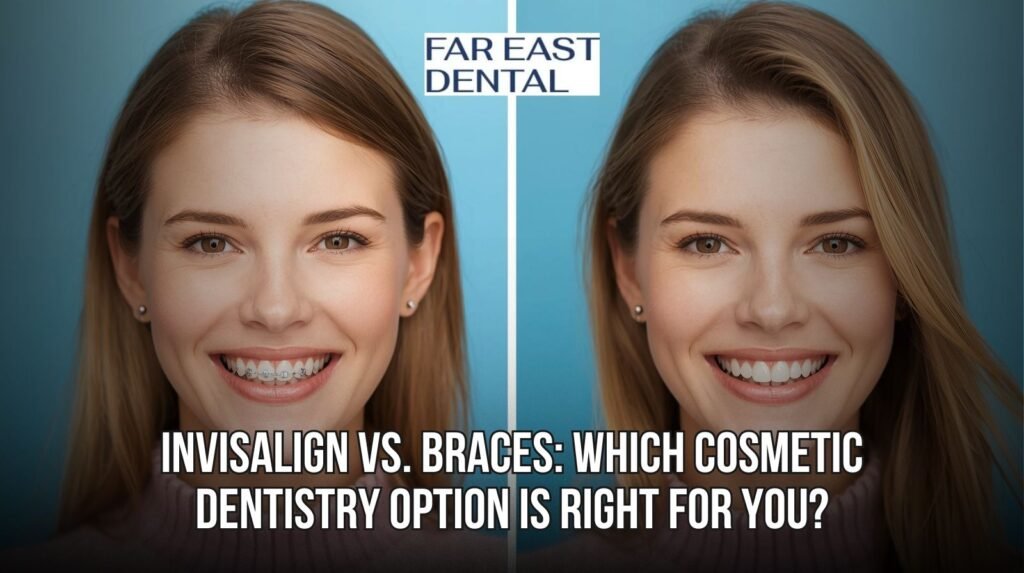
Do you turn away when someone pulls out their phone for a group photo? If yes, then you are not alone; most people live with teeth they are not happy with. Some have gaps, others deal with overcrowding, and many have that one stubborn tooth that never got the memo about where it should sit. With Cosmetic Dentistry Edmonton, you can transform your smile, correct imperfections, and feel confident every time you face the camera.
The thing is, fixing your teeth doesn’t have to mean going back to middle school with a mouth full of metal. Sure, traditional braces still work great, but now there are other ways to get straight teeth without everyone knowing you’re getting treatment.
Invisalign has revolutionized the orthodontic industry for many people. Those clear trays are invisible, which sounds perfect until you start looking into the details. Both options have their pros and cons.
You may be wondering which one actually works better. Or you want to know about the pain factor, because let’s be honest – nobody wants their mouth to hurt for months. Cost is on your mind too, since neither option is cheap.
Here’s what you need to know about both choices.
Braces are not rocket science, certainly, but they are still more complicated than simply putting some metal on your teeth and hoping.
Your orthodontist begins by cleaning your teeth with great care and then applies a special paste to attach small metal squares, referred to as brackets, to every tooth. When they are on, they are not coming off until they are treated. Then there is the wire, which passes through all the brackets and is glued in place with small rubber bands.
All of the lifting is being done on that wire. It is composed of the materials that strive to revert to a particular shape, and, therefore, it is always attempting to straighten itself. When it does so, it drags and trudges your teeth with it. Your teeth don’t just slide around, though – the bone in your jaw actually changes shape to accommodate the new positions—pretty wild stuff.
Braces can correct nearly any issue with your teeth. Even teeth that look hopeless can usually be straightened with enough time and patience. Complex bite problems, teeth that are rotated weirdly, significant gaps, severe crowding – braces handle it all.
Money matters, and braces typically cost less than other options. Insurance companies have been covering braces for a long time, so they usually pay for a significant portion of the treatment. That makes a difference when you’re looking at thousands of dollars.
Invisalign is basically the opposite of braces. No metal, no wires, no brackets glued to your teeth. Just clear plastic trays that resemble the whitening strips people use at home, but thicker.
Your orthodontist takes pictures and scans of your teeth, then sends all that info to a lab. The lab uses computers to determine how to move your teeth from their current position to their desired location. They create a variety of trays – possibly 30 or 50, depending on your situation.
Each tray is slightly different. The first one fits your teeth exactly as they are right now. The second one is made for where your teeth should be in two weeks. The third one is for where they should be in four weeks. You get the idea.
You wear each tray for two weeks, then discard it and proceed to the next one. Every time you switch trays, your teeth are gently pushed a little bit closer to their final position. It’s like someone’s gently nudging your teeth into place over many months instead of yanking them around with metal wires.
Nobody can see them. That’s the main reason most adults pick Invisalign over braces. Your coworkers won’t know, your friends won’t know, and even your dentist might not notice at first glance.
Food becomes normal again. With braces, you can’t eat corn on the cob, apples, caramel, gum, popcorn – the list goes on forever. With Invisalign, you can remove the trays and eat whatever you want. Then brush your teeth and put them back in.
No broken brackets, no poking wires, no emergency orthodontist visits because something came loose. The trays are smooth and don’t cut up your mouth.
They don’t work for everything. If your teeth are severely misaligned, such as being significantly crooked or you have major bite problems, Invisalign might not be the right solution. Some teeth just need the more potent force that braces provide.
You can lose them. And when you do, you’re stuck waiting for replacements while your teeth start moving back to their old positions. Ask anyone who’s done Invisalign – they’ve all lost a tray at least once.
They’re annoying to deal with. Taking them out every time you want coffee, putting them back in after every meal, carrying around that little case everywhere. Some people get sick of the routine fast.
Your teeth hurt every time you switch to a new tray. It’s not terrible pain, but it’s definitely uncomfortable for a few days each time.
Success Rates and Results
Studies indicate that the two therapies are very effective when administered to the proper case. The more common orthodontic issues are typically treated with traditional braces, while Invisalign is suitable for minor to moderate alignment issues.
The period of treatment varies depending on the complexity of the cases, rather than the method used. Easy cases would be resolved in 12-18 months under both treatments, and complicated issues may take 24-30 months, regardless of the treatment method.
Age Considerations
Aesthetic and lifestyle benefits are the reasons why adults choose Invisalign. Nevertheless, there are adult patients with complex orthodontic requirements in whom conventional braces are more responsive. The ideal treatment is not based on age.
There are special considerations for the two treatments among teenagers. The Invisalign Teen has a built-in capability to suit the developing jaws, though compliance is an issue. Traditional braces can eradicate compliance problems, but they can also affect the social lives of teenagers.
The children are usually provided with traditional braces since removable aligners do not work well with the majority of young patients. Nevertheless, some adolescents are responsible enough to be treated with Invisalign.
Making the Right Choice
Consultation Importance
It is a professional evaluation in a dental clinic in Edmonton that identifies the best type of treatment that can meet the needs of an individual. When making treatment decisions, orthodontic assessment considers the position of the teeth, the interrelationships of the bites, the alignment of the jaws, and facial aesthetics.
Digital imaging and treatment planning help patients visualize the anticipated outcomes using various methods. With this technology, informed decision-making becomes possible because predictions are made based on the results of predicted outcomes, rather than assumptions.
Lifestyle Factors
Many adults are affected by career demands, which can influence their treatment choices. Professions that face the public could utilize the discretion of Invisalign, while other occupations may not be as concerned with the visibility of treatment.
Athletes influence the choice of treatment. Contact sports may be more favorable for the removability of Invisalign, and other activities are not a problem with traditional braces when properly guarded.
Financial Planning
Insurance coverage varies significantly depending on the type of treatment being received. The classic braces usually cover better, although specific plans cover Invisalign benefits. Surveying the insurance information helps identify the real out-of-pocket expenses.
Treatment is made cheaper through payment plans. Most cosmetic dentistry professionals in Edmonton offer alternative financing schemes that allow patients to pay in manageable monthly installments.
Look, both options work. The question is which one works better for your life right now.
If your teeth are a hot mess – really crooked, big bite problems, the whole nine yards – you’re probably looking at braces whether you like it or not. Invisalign simply cannot handle the heavy lifting that some teeth require.
Money talks, too. Braces cost less upfront, and insurance typically covers a larger portion of the bill. If you’re already stretching your budget, that might be a deciding factor for you.
Here’s what really matters, though – find an orthodontist who’s honest about what you need. Some will try to sell you the more expensive option when the cheaper one would work fine.Ready to examine your orthodontic solutions? Contact Far East Dental Edmonton today to book a consultation and review which treatment best meets your lifestyle and objectives.

Far East Dental Centre offers convenient, comprehensive dental services for Edmonton families and individuals.
© 2026 Far East Dental – Precision in Dentistry, Precision in Design — Webital Technologies & Signages